

Newsletter subscription
Several times per year, the Mermet company will inform you of:
- the latest innovations in sun protection fabrics
- recent projects completed
- new tools and services available
- events and exhibitions
It is universally recognised that noise is both a nuisance and a proven health hazard. The proof is that half of the population of Europe lives in a noisy environment and one third of that population have their sleep disturbed by background noise. Workplaces, leisure environments, MP3 players, etc. - other sources of excessive noise can also cause serious damage to your ears. Consequently it is essential to warn and inform people about the health risks involved. This is why most European countries are dealing with this issue by enacting noise prevention regulations in order to increase acoustic comfort in new buildings.
The campaign against noise, controlling background noise, the intelligibility of spoken words...are all leitmotivs for managers, designers and builders these days in the urban planning sector. Their goal? To provide sensitive users with optimal acoustic comfort.
To fulfil these needs, Mermet offers Acoustis® 50, the only absorbent material that is acoustic AND decorative. Acoustis® 50 is the first patented solution based on exclusively weaving coated fibreglass with a special weave and a controlled diameter; this weaving is the first to provide textiles with such a level of acoustic absorption...
The science of sound, its emission, propagation and reception. By extension, it encompasses all of the techniques aimed at improving the sound dissemination quality in all rooms.
An auditory sensation produced by a rapid variation in air pressure. An acoustic vibration which is propagated in the form of a mechanical wave.
It is characterised by the frequency (Hz) and the sound level (dB).
The frequency, which is measured in Hertz (Hz), gives the number of vibrations per second.
It enables a distinction to be drawn between bass sounds (below 200Hz), mid-range sounds (200 to 2,000Hz), and treble sounds (above 2,000Hz). The human ear is capable of hearing sounds on frequencies between 20 and 20,000 Hz. In the construction sector, usually you work within a frequency range of 125 to 4,000 Hz.
A unit for measuring the sound level. Levels audible to the human ear :
0 dB = hearing threshold. 120 dB = pain threshold.
Different from acoustic insulation, it deals with the control of the propagation of sound within a room in order to control the sound level and optimise listening qualities.
It offers various possibilities :
A wise choice of materials that takes into account their absorption coefficient, the room's surface area, and the reverberation time, provides very good acoustic correction.
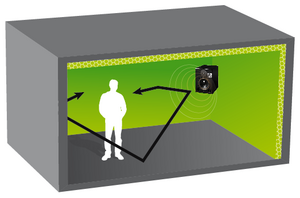
This energy consists of transmitted energy and reflected energy.
The quantity of energy reflected, and therefore the sound environment, depends on the material, shape and state of the surfaces of the walls.
The time that sound takes to decay by 60 dB after the sound source stops. It is measured in seconds.
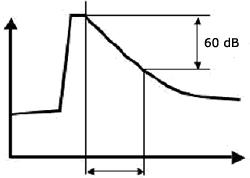
For good intelligibility, the reverberation time depends on the volume of the room.
|
Type of room |
Reverberation time |
|
Office |
0.4 - 0.7 s |
|
Conference room |
0.6 - 0.9 s |
|
Cinema |
0.6 - 0.9 s |
|
Classroom |
0.5 - 0.8 s |
|
Theater |
0.9 - 0.13 s |
The incident sound energy on the walls is split into transmitted energy, reflected energy and absorbed energy.
Depending on the material of the room's walls, it is possible to influence the quantity of energy absorbed and therefore reflected. The suitability of a material is assessed using the Alpha Sabine coefficient (αw) per frequency, which equals the following ratio : absorbed energy / incident energy.
Without absorption, the reverberation time and the sound level increase in the room.
Providing sensitive users with optimal acoustics at two levels:
This first level consists of seeking to achieve good intelligibility of spoken words in the room being studied.
A speaker who talks normally must be fully understood by his listener, regardless of his location. The room must have reverberation that is neither too high (when syllables are superimposed, this leads to a loss of intelligibility), nor too low (an absence of reflection of the signal leads to the feeling that you are in a dead room).
This second level consists of reducing and limiting ambient sound levels prevalent in the room. The reverberation periods must be short there in order to limit the propagation of sound within the space to the maximum extent.
So what you are seeking to achieve then is a sound decay close to a free field (like outdoors).
When a speaker is talking in a room, the listener perceives the direct sound and the sound that is has reverberated off all the walls. In fact, what the listener hears is a signal characterised by its initial sound level, in addition to the same signal generated by the sound being reflected off the walls.
This second signal is almost the same as the direct sound, but involves a time delay.
All these reflections can reinforce the sound level received or, to the contrary, can give rise to a loss of information when the "tailing off" of previous syllables masks the direct sound.
Characterisation of the transmission channel between the speaker and listener is directly linked to the study of acoustic characteristics. Two of them are essential for understanding spoken messages :
The reverberation time is determined by knowledge of the sound decay over time.
Thus, for any room, controlling spatial and temporal decays is vital. These values depend on the shape and dimensional characteristics of the rooms, as well as on the acoustic absorption coefficient of the various walls, and that of the furniture.
Restaurants, meeting rooms, sports complexes, covered swimming pools, school canteens, covered school playgrounds, exhibition stalls or railway station halls, etc. - in all these locales, people's discussions create a high sound level (75 to 95 dB(A)) and a relatively stable ambient noise, but which is often perceived as a hubbub. When this reaches a certain value, the people present have to raise their voices or even shout in order to continue to communicate because it is the intelligibility of spoken words which ensure they are properly understood. This intelligibility depends on the ratio between the signal (the spoken words) and the ambient noise (the hubbub).
However, the power of people's voices is limited and the people present end up speaking less, which stabilises the ambient noise.
Thus, under certain acoustic conditions and site occupation conditions, you reach a situation where the people present are responsible for the cause and are the victims of the effect. This escalation of the sound is called “the cocktail effect" and can be avoided by preventing the threshold at which it occurs from being reached.
Measurements characterising this change in the
sound levels depending on the locales and the people there (adults or children) have enabled to establish thresholds which should not be exceeded.
The uncomfortable phenomenon known as the cocktail effect begins at a threshold which differs for adults and children, who often speak loudly or shout. Thus, for locales such as restaurants or other places where people gather, in order to avoid this cocktail effect, it is desirable to avoid exceeding 72 dB(A). On the other hand, for locales for children, it is desirable to avoid exceeding 80 dB(A) because above and beyond that, there is a risk of the professionals who work there going deaf.
 |
 |
|
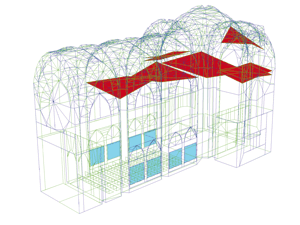
Acoustical panels Acoustical wall panels |
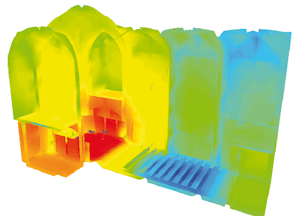
Sound distribution generated by a quartet after acoustic treatment 1 dB(A) per change of colour |
Acoustic absorption reduces the reflection of sound waves in a room. This should not be confused with acoustic insulation, which prevents sound being transmitted between rooms. Absorbent materials reduce sound levels in a room because while sound crosses them repeatedly it loses some of its energy.
Acoustis® 50 is the first patented solution based on exclusive weaving of coated fibreglass with a special weft and a controlled diameter. The technology of its special weave gives Acoustis® 50 a high acoustic absorption capacity. Perfect control of the material's porosity helps to absorb sound waves without adding any fibrous or porous material.
The acoustic performance of Acoustis® 50 varies with the function. For free-floating fabric, acoustic absorption, expressed in alpha Sabine (αw), is around 0,35. For tensile or frame-stretched structures, acoustic absorption is about 0,8 αw.
Apart from acoustic control, Acoustis® 50 fulfils many other functions: space layout, solar protection, light control. Printable, it can be used as a communication and graphics medium.
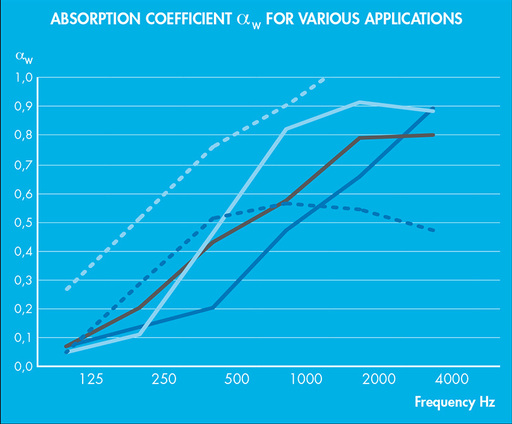
The acoustic absorption capacity of the material is expressed by its acoustic absorption factor (aw) in the 3 octave bands: bass (below 200 Hz), medium (200 to 2000 Hz), treble (above 2000 Hz).
A high absorbing material will tend towards 1.
Blind  0,3 < α W < 0,55
(depending on plenum*)
Panel on load-bearing structure 0,4 < α W < 0,75
(depending on mounting system)
Velum α W = 0,45
* Gap behind the fabric
* NRA - ISA 11654 : fire classification M1
Several times per year, the Mermet company will inform you of: