

Newsletter subscription
Several times per year, the Mermet company will inform you of:
- the latest innovations in sun protection fabrics
- recent projects completed
- new tools and services available
- events and exhibitions
Today, solar protection is a key element in intelligent building design to reduce energy consumption, protect occupants and maintain comfort levels. Our core business consists of designing, manufacturing and promoting high-performance technical fabrics that offer genuine functional and aesthetic added value to any architectural project.
Thermal and optical values, as defined in the European standard EN 14501 (Blinds and Shutters, Thermal and Visual Comfort, Performance Characteristics and Classification), are used to measure the performance of a fabric's solar protection properties. The standard is based on a number of criteria and establishes various comfort classifications: :
There are 5 levels of performance classifications:
0 very little effect - 1 little effect - 2 moderate effect - 3 good effect - 4 very good effect
The EN 14501 standard defines the total solar factor gtot (fabric + glass) as the most important property for thermal comfort and the Tv value for visual comfort.
To calculate the total solar factor, two calculation standards are used:
Solar radiation is always partially transmitted through, absorbed or reflected by the fabric. The sum of all 3 equals 100.
Ts + Rs + As = 100% of solar energy.
According to several studies, an office exposed to a temperature of 25°C to 30°C leads to a 2 % loss in productivity. This figure can be as high as 10% when the temperature exceeds 30°C.
The solar factor determines the percentage of solar energy entering a room through the blinds and the glazing.
It is called gtot according to the EN 14501 standard (transmittance of solar energy) an it is expressed by an index of 0 to 1.
The closer the fabric's index is to 0, the more efficient it is in terms of protecting against the heat.
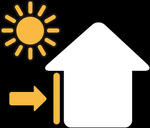
External blinds offer better thermal protection than internal blinds because the solar radiation, which is partly absorbed (As) by the fabric before reaching the glazing, is reflected outwards.
Dark colours protect better against the heat than light colours because they absorb more solar energy (lower Ts). The Mermet® fabrics may meet the requirements of EN 14501 standard (class 4) depending on colours..
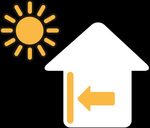
Conversely, light colours are more efficient indoors. They absorb less heat (lower As) and reflect it more (Rs) than dark colours.
The emissivity of a material is its ability to re-emit the energy received through conduction (heat/cold).
A fabric with a low level of emissivity will limit the effect of inward radiation by limiting how cold it feels in winter and how hot it feels in summer.
The energy emitted through this reflection is kept inside so reducing air conditioning and heating consumption which in turn helps reduce energy consumption.
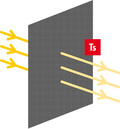 Solar Transmittance
Proportion of solar energy transmitted through the fabric. A low percentage means the fabric performs well at reducing solar energy.
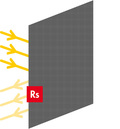 Solar Reflectance
Proportion of solar radiation reflected by the fabric. A high percentage means the fabric performs well at reflecting solar energy.
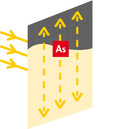 Solar Absorptance
Proportion of solar radiation absorbed by the fabric. A low percentage means the fabric absorbs little solar energy.
Percentage of solar energy which actually penetrates into a room through the blind and glazing. A low value means good thermal performance.
Gtot solar factor is determined for 4 standardized glazings as defined in Annex A of EN 14501 standard. The base glazing is C (thermal transmission factor of the glazing alone U = 1.2 W/m²K - solar factor of the glazing alone gv = 0.59).
Dark colours offer better transparency and enhanced glare control.
On the contrary, the lighter colours diffuse more natural light.
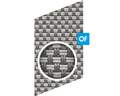 Openness Factor (OF) = Tvnn
Relative area of the openings in the fabric (hole). It is considered as independent of the colour. For fabrics with the same weave, it should be measured using the darkest colour in the range.
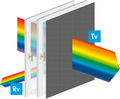 Visible Light transmittance (Tvnh)
Total percentage of light radiated through the fabric over a wavelength of 380 to 780 nm (nanometers), called the visible spectrum (total illumination).
Proportion of light reflected by the fabric.
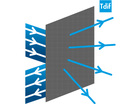 Diffuse transmission factor (Tdif)
Correlation of the two factors above: Tdif = Tv – OF.
It is indicated as Tvndif for the aspects of glare and shape recognition (outward visibility / night privacy). A low figure shows a better visual comfort.
However, for natural light control, it is indicated as Tvdifh. It is used to ascertain a fabric’s light diffusion capacity. A high figure means more natural light.
Tv = Tvnh = Tvnn + Tvndif
Natural light, which is variable, constitutes an important factor for well-being. Consequently, it should be managed properly in order to avoid glare, which is an intense source of eye fatigue, particularly on computer screens.
As is the case with heat, visual comfort guarantees the efficiency of employees while they work and forms the subject of regulations* setting their work conditions.
Factors enabling glare control to be measured are the optical factores Tv or TL (Visual transmission) and OF (Openness factor).
All fabric weaves are effective for controlling glare. They must be chosen based on the global geographic location and the layout of the buildings.
Solar protection fabric enables the window's level of luminance to be controlled (natural light diffused in the room) and a reduction in disturbing light & dark contrasts within the field of vision. Depending on its colour, a solar protection fabric can become a light source if sunlight strikes it directly.
An example of the level of luminance of surfaces according to standard NF X 35-103 :
For your information, a sheet of paper = 100 Cd/m², a computer screen = 50 Cd/m².
Dark fabric provides better control of glare because it diffuses less light.
The fabrics in the Mermet® collection have excellent glare control properties due to their various openness factors (OF) and weaves. They can filter up to 99% of light rays.
Natural light governs a number of endocrinal functions, and regulates sleep and the body's water balance. It improves the working conditions experienced by employees
Depending on the sectors in question, it is nevertheless necessary to have a greater or lesser degree of natural light or to avoid it getting into a room by dimming out or blacking out the room.
The solar protection fabric acts on light provided and on the level of dimming out or blacking out.
The level of incoming light varies depending on the opening coefficient (OF). The higher it is, the more the light will get through. The Tv value, for its part, depends on the colour and determines the clarity or brilliance.
A blind fitted with Mermet® fabrics must therefore control incoming light and, as it turns out, the luminance and illuminance levels.
Fabrics from the Mermet® collection allow the best of the natural light to pass through. They thus enable the consumption of artificial light to be limited and enable energy savings, which is a good way of limiting greenhouse gas emissions.
They have several weaves and opening coefficients (up to 10 %) which allow a greater or lesser level of incoming light.
To completely exclude the light, select the 100% Blackout fabrics.
Fabrics in the Mermet® collection also provide interior protection against the discolouration effect of ultraviolet light (UV). They block out between 90% and 100% of the light depending on the fabric. UV accelerates natural ageing.
Outward visibility, which is essential for enabling you to maintain a concept of time and space, is essential for your mental balance.
It reduces stress and contributes to improving productivity.
Again, depending on the room and the orientation of the window, the transparency performance characteristics of a solar protection fabric will be determined by its opening coefficient (OF), its colour, its weave and its manufacturing process.
As a matter of fact, thanks to the fibreglass's regular coating, the fineness of these fibres, and the regularity of the weave, Sunscreen® fabrics offer a very clear outward visibility.
Giving priority to dark colours facilitates transparency.
For maximum transparency, the Sunscreen® family offers open fabrics (OF > 5 %) and large widths enabling median joins (weldings) to be limited..
Conversely, to protect your business and staff from people looking in at them when the premises are lit up at nighttime, it is preferable to opt for a solar protection fabric from the Blockout family.
Mermet® solar protection fabrics are perfectly suited to mechanisms with ZIP-type side guides.
Several times per year, the Mermet company will inform you of: